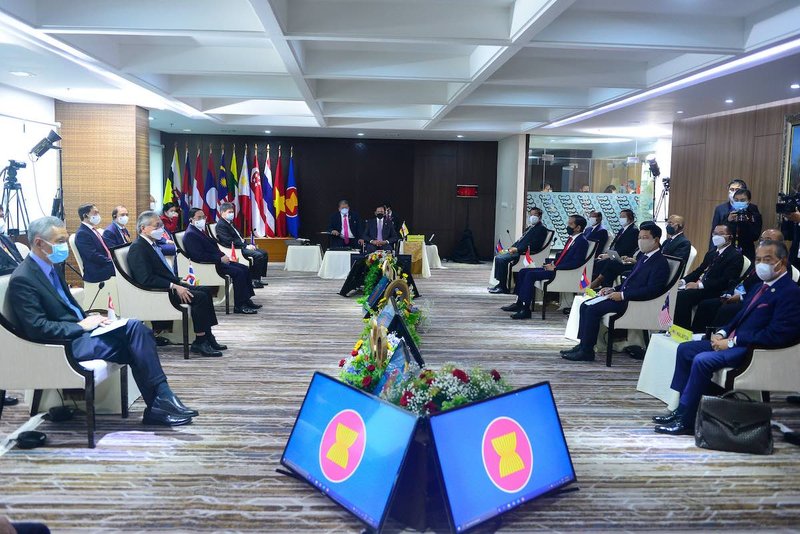
It has been a month since the ASEAN Leaders met with Myanmar junta Leader Min Aung Hlaing on 24 April in Jakarta to discuss the situation in Myanmar. The meeting itself and the outcome of it – the Five-Point Consensus – has been applauded by some as a rare win for ASEAN, given its limitations in addressing crises, and derided by others as legitimising the coup and strengthening the hand of the military.
Any optimism on the “ASEAN way” forward, however, is fast evaporating with the absence of a clear implementation plan for the five-point-consensus, the delayed announcement and specific objectives of the ASEAN envoy, the continued violence against civilians by the Tatmadaw (Myanmar’s military forces), and the displacement of thousands of people in the border states. Critics of ASEAN have called out the regional grouping for not condemning the violence of the Tatmadaw and allowing the State Administrative Council (SAC) to buy time to consolidate power.
So far, dialogue partners including Australia and the United States have rallied around the five-point-consensus, and apart from targeted sanctions, they have been relatively constrained in their policy responses to the coup. This is in part a recognition of the limited leverage they have over the junta and that despite its limitations, ASEAN is the only and best option available towards resolving the crisis in Myanmar. While the five-point consensus has its shortcomings, it provided a path forward for ASEAN to address the political and humanitarian crisis in the country. Prior to this, the international community did not have many options to begin with.
As one expert on Myanmar has pointed out:
Someone has to talk to the coup leaders about how they may get out of the hole they have dug for themselves, and there aren’t many who are both willing and able to take on that thankless task.
The appointment of an ASEAN envoy who would help broker dialogue among the concerned parties is a key component of the five-point consensus. Several names have been suggested, including former Indonesian foreign minister Hassan Wirajuda and former Prime Minister of Singapore Goh Chok Tong. As the Chair of ASEAN, however, Brunei has yet to name the envoy. It is likely that this person would have to be “approved” by Min Aung Hlaing before being named publicly.
The SAC is unlikely to enter into any mediation process if they could not get what they want – i.e., preservation of their central role in Burmese politics. As unpalatable as it might sound to the National Unity Government (NUG), protestors from the civil disobedience movement, or the international community, the ASEAN envoy would likely have to accord some degree of legitimacy to the SAC in order to keep them engaged. He or she will also have to recognise the differing interests and political motivations of the SAC, NUG and the ethnic armed groups (EAGs).
Regardless of who the ASEAN envoy is, the appointment should also not be seen as a silver bullet. The junta has already rejected any visit by the ASEAN envoy, stating that it is “prioritising the stability and security of the country”.