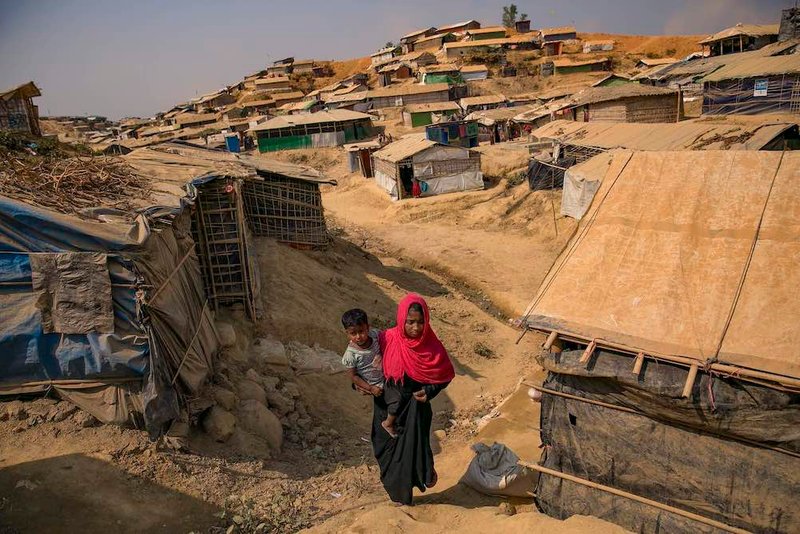
In the April 2019 Regional Outlook, APR2P gave an update on the situation facing Rohingyans in Myanmar and the refugee camps of Bangladesh. It also issued strong recommendations in relation to Brunei’s implementation of the death penalty for homosexual acts, and included a new section on sexual and gender based violence. Human rights violations in the Philippines and violent Islamic fundamentalism in Mindanao were also raised. A separate report co-written with the Global Centre for the Responsibility to Protect described China’s ongoing persecution of the Uighurs.
Yet too often, early warnings such as these are not taken into account in the development of government policy or global action. Certainly politics is one factor, but so too is indifference. For example, no amount of early warning was able to generate the political will to act to protect Rohingyans from atrocity crimes in 2017. Despite the Centre’s Regional Outlook repeatedly highlighting a very high risk of atrocity crimes in Rakhine State over a number of years, the actual outbreak of atrocities was met by a mixture of shock, uncertainty, indifference, and dithering. Early warning, we learned, does not necessarily produce better responses.
The principle of “Responsibility to Protect” (R2P) developed in light of international failures in Rwanda and the Balkans in the 1990s. In 2005, UN member states unanimously agreed to the principle, which attempts to reconcile international humanitarian and human rights law with notions of sovereignty and non-interference. R2P holds that inherent in the concept of state sovereignty is that state’s primary responsibility for the protection of its population. When a state fails in its responsibility to protect its civilian population from war crimes, crimes against humanity, genocide or ethnic cleansing, the international community has an obligation to intervene, and can do so in a range of ways.
Yet of paramount importance within R2P is the value of prevention, including the prevention of incitement.
Australia has shown leadership in the past in implementing the R2P concept even before it was officially adopted by the UN. This is notable in Australia’s response to the 2003 request from the government of Solomon Islands to help restore law and order. Although long, the 14-year program to help build capacity in Solomon Islands has been effective and aligns precisely with the values of R2P in reconciling state sovereignty, protection of civilian populations and the obligation of the global community to assist states to meet this responsibility.
Regional and civil society organisations are active in the Asia Pacific in monitoring and raising awareness of human rights violations and signs of imminent atrocities. APR2P works closely with those organisations to build connections with governments and the United Nations.
But more needs to be done to bridge the gap between knowledge on the ground, early warning reports, and international responses to potential or actual atrocity crimes. This month, and every year, is already overflowing with victims.
Alex Bellamy , Nikki Marczak