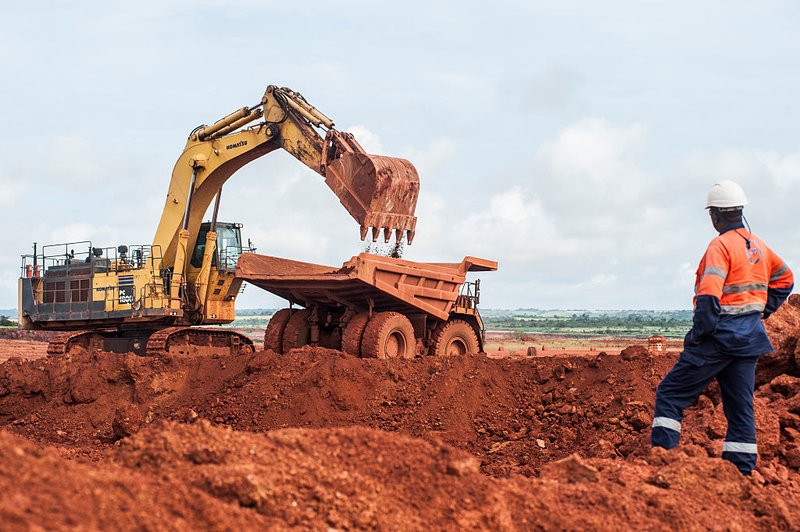
For example, China has laid its eyes on Guinea’s bauxite reserves, one of the world’s largest, to keep its aluminium industry running. Promising a loan double the size of its GDP, mining projects in Guinea’s Boké prefecture under the auspices of Chalco and TBEA Co Ltd, as well as in Télémilé district with CDM Henan China, are well underway. In 2018, SMB-Winning Consortium, made up of Wining Shipping, logistics firm UMS and aluminium producer China Weiqiao, promised US $3 billion into infrastructure and smelter projects in Boké. That same year, another Chinese aluminium firm, Zibo Rundi, was awarded a 25-year mining concession containing 1 billion tonnes of bauxite.
These deals are cementing Guinea’s position as the main bauxite exporter for China. Last year, Guinea exported 38.2 million tonnes of the aluminium precursor to Chinese smelters. The problem is that deals concluded between Beijing and African governments are hardly the “win-win” outcome Beijing promises.
In Guinea, the population is benefitting little from the bauxite boom. In May last year, workers at a Boké mine went on strike for two weeks in protest over the arrest of a union leader. A volatile region due to the wealth discrepancy between the mining companies operating there and the poor local population, riots broke out in 2017 over health and environmental issues, brutally suppressed by government forces. More recently, in April, workers at the CDM-China-owned mine in Telimélé district went on strike demanding better working conditions.
In Zambia, similar conditions for the local population prevail. Having invested there for its rich copper mines, China has moved men and machinery to the country, replacing Zambian with Chinese workers and causing a spike in unemployment in the country’s mining heartland in the process. Safety regulations for locals are routinely flouted as miners are required to work for two years until they are given basic protective gear. The situation has escalated since 2015, and Zambian observers assert that the “influx of the Chinese … will threaten the sovereignty and security of the country.”
These examples show that China’s foreign policy exhibits a pattern of exploitation and one-sidedness akin to the former colonialism of Western powers. But it is doubtful that China will change its ways any time soon and adapt its policies to the benefit of local populations rather than simply benefitting from them. After all, China considers itself a bringer of development – in stark contrast to the conditionality of Western development aid.
This view is based on China’s self-perception as a victim of former Western imperialistic aggression itself. Consequently, Beijing is unable, as one analyst put it, “to view its actions as anything but benevolent and its tendency to ignore historical echoes.”
And unlike in other regions where China is forcefully pushing ahead, African leaders are unwilling – or unable – to push back and effectively negotiate better terms for the deals. At the 2018 Forum on China-Africa Cooperation (FOCAC), African leaders drowned China in praise in a unmistakable sign of how indispensable the Middle Kingdom has become to them, in contrast to the United Nations, United States and European Union.
With the writing thick on the wall, it is clear that the West has neglected Africa as its former sphere of influence and has lost ground to Beijing. But for African countries hoping to escape Western conditionality by embracing China, a rude awakening is coming, no matter how hard China’s top diplomats are denying it: far from being the better choice, colonialism is back – but this time with Chinese characteristics.
Anthony Kleven