Subscribe to The Informer for monthly expert analysis, and to Events for advance notice of visiting world leaders and distinguished guests.
You may unsubscribe from Lowy Institute newsletters at any time. For information on our privacy practices and how to unsubscribe, see our Privacy Policy.

The most-pressing world events explained by Lowy Institute experts and global contributors, in your inbox, every Wednesday.
You may unsubscribe from The Interpreter at any time. For information on our privacy practices and how to unsubscribe, see our Privacy Policy.
Australia, explained.

US Navy divers with an underwater engineering and construction team (Charles E. White/US Navy)
Underwater vulnerabilities need to be far more prominent in the conversation.
About the author
Samuel Bashfield
Samuel Bashfield is research fellow at La Trobe University’s Centre for Global Security.
Australia is yet to adequately grapple with the unique challenges that critical seabed infrastructure protection poses to its defence and national security.
In Europe, recent critical seabed infrastructure incidents have rattled leaders. Nord Stream and Balticconnector have entered the public lexicon as examples of vulnerability. In May 2023, NATO’s intelligence chief David Cattler warned of “heightened concerns that Russia may target undersea cables and other critical infrastructure in an effort to disrupt Western life.” Cattler went on to say this could be an effort to gain leverage against those nations providing security to Ukraine, adding “the Russians are more active than we have seen them in years in this domain.”
Around the same time another NATO official private expressed suspicions that “somewhere in Moscow there are people sitting and thinking of the best ways they can to blow up our pipelines or cut our cables.”
Cables carry approximately 98% of data communication globally.
And it is not just in Europe where the alarm has sounded. Cut cables at Taiwan’s Matsu Islands and incidents in the Red Sea have prompted capitals to consider defensive actions. The isolation that is inherent to much of this infrastructure has allowed claims that cables have been inadvertently damaged. Yet as analyst Elisabeth Braw has warned, “given the world’s dependence on the cables and the few ships that can service them, the near future offers tempting prospects for any country ready to create a few more “accidents” at sea.
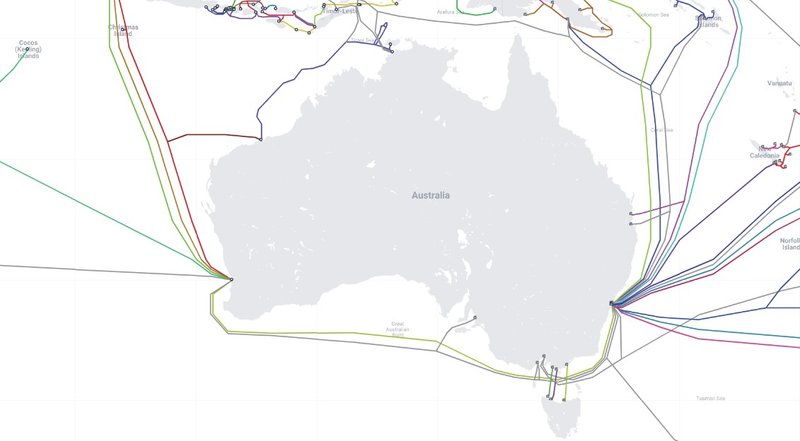
While the seabed hosts a range of critical infrastructure, the most important to modern society are submarine cables. These cables carry approximately 98% of data communication globally. The 500 plus submarine cables which transit the globe carry all manner of data, including private communications (e.g. email and messaging services), banking data, stock market data, medical data, scientific data, government communications, traffic between data centres, and video streaming.
These seabed lines of communication are understudied and underappreciated, particularly in Australia.

New diplomatic initiatives, including Australia’s new Cable Connectivity and Resilience Centre and the Australia, US, Japan Trilateral Partnership or Infrastructure Investment in the Indo-Pacific have been launched to improve cable resiliency regionally, and Australia is a leader in submarine cable protection zones.
However, more steps are available to Australian defence policymakers to address the threats associated with protecting critical seabed infrastructure.
As an island nation, Australian reliance on this underwater infrastructure cannot be avoided.
Seabed lines of communication cannot be taken for granted. And as an island nation, Australian reliance on this underwater infrastructure cannot be avoided so must be protected.

The awkward job of laying down submarine cables (Stefan Sauer via Getty Images)
This article draws on findings in a research article “Defending Seabed Lines of Communication” recently published in the Australian Journal of Maritime & Ocean Affairs. These articles were written and received funding as part of the author’s Non-Residential Fellowship with the Royal Australian Navy’s Sea Power Centre – Australia. All views expressed are solely those of the author and do not necessarily represent the Royal Australian Navy or any other organisation.