The bitter irony is that Western deterrence of Putin would have been much stronger if Europe had acted earlier to reduce economic dependence on Russia and the West had sooner, and more clearly, articulated its willingness to impose sweeping sanctions, including on Russia’s Central Bank.
Constraining – or at least raising the cost of – Beijing’s assertive revisionism and use of economic and military coercion also requires a common economic approach, along with stronger military deterrence.
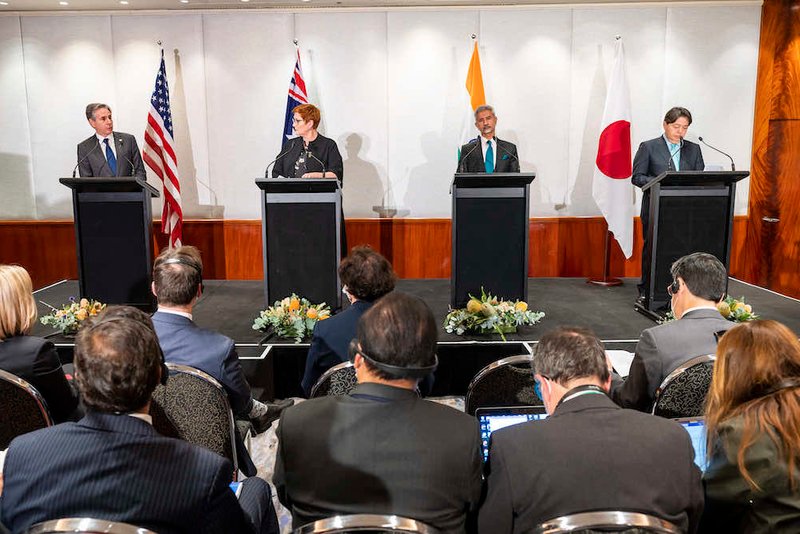
The Ukraine crisis is a lesson in the importance of acting sooner rather than later. It should spur related work already underway in the Quad and G7, and produce a framework for cooperation that spans both the Atlantic and America’s close partners in the Indo-Pacific. Learning from Europe’s dependence on Russian energy, this could take the form of more collective or coordinated action to reduce dependencies on China and control technology exports where these have strategic implications. It could also extend to agreeing – in advance – what collective economic measures Western states would take in response to a Chinese invasion of Taiwan. If it were to become necessary, this could be communicated to Beijing quietly but credibly.
There are of course risks. China is already pursuing its own partial de-coupling from the West. Still, more economic pushback against China will play into its narrative of grievance. Deft diplomacy would be required to reassure Indo-Pacific countries, especially in Southeast Asia, already anxious about the risk of conflict.
Global events will keep throwing up these difficult trade-offs. In all the uncertainty following the invasion of Ukraine, some things are clear. The global contest of values and interests, of sharply divergent visions of global order, that has so shaped Australian foreign policy in recent years is now dramatically intensified. The borders between the democratic and authoritarian worlds have further hardened, the space for cooperation across them further narrowed.
And while the post-Cold War era might be over, Putin has given the defence of liberal values greater meaning and urgency than ever. The bifurcation of Australian foreign policy evident in recent years will therefore become more pronounced. On the one side, deep engagement with Asia. On the other, Australia acts now as the southern anchor of a global coalition of democratic countries standing in defence of liberal values. There will at times be a tension between the two, but this is inevitable and necessary; managing it is the task of a generation or more.
Ben Scott , Richard Maude