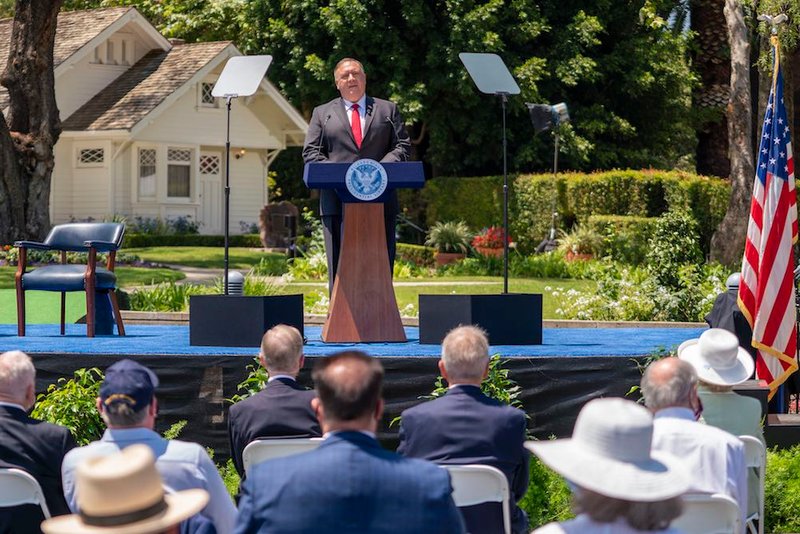
The Trump administration’s first-term regional policy has been an incoherent mess. While these latest moves are an attempt to achieve more consistency than in the past, it is more than likely that the gambit to toughen up on China will fail to achieve its desired ends. There are several reasons for this beyond the basic fact that the government under Trump has been unable to develop and advance a consistent approach to US interests in Asia.
The contrast in tone and means between the White House’s China strategy published in May and the content of Pompeo’s speech is illustrative of an administration that speaks in multiple and non-harmonic voices about its Asia policy. Equally, the tough messaging sits uncomfortably with the reality of presidential action in relation to China, most obviously the limp January trade deal and the soft treatment of Xi Jinping by Donald Trump over many years.
As the Brookings Institute’s Tom Wright has pointed out, one of the major problems with the framing of US policy in values-based terms is that it is at odds with key aspects of US foreign policy under Trump. Washington has signalled highly inconsistent attitudes toward human rights, democracy promotion and values more generally. He has been cavalier in the treatment of democratic allies, while according to former national security advisor John Bolton, he encouraged the PRC’s horrific treatment of Uyghurs, to say nothing of Trump’s heedless approach to democratic norms domestically.
Trump and his government have demonstrated a love of bombastic rhetoric unmatched by substantive action. The approach to North Korea is typical of this. Trump dialled up the tensions to a very dangerous level and then settled for two photo-op summits that benefitted Kim Jong-un and led nowhere except to the tacit acceptance of the Democratic People’s Republic of Korea as a nuclear power. Beijing has noticed this tendency to talk loudly and carry virtually no stick. So it is unlikely this latest attempt to push a harder line will change PRC behaviour.
A further way in which this flurry of activity is illustrative of the shortcomings of US Asia policy is that it dials up the rhetorical temperature to no great advantage. Indeed, for many allies this needless escalation is counterproductive, as this kind of unsubtle statecraft narrows their strategic room for manoeuvre, to no benefit for anyone.
It is important that the US is clear about its strategic intent – in the past, there was a little too much Voldemort-style ambiguity about Washington’s approach to China, as in never to directly name the enemy. But the failure to think through the ends and means of US policy, with clumsy public messages too focused on domestic matters and no consideration of allies has been all too typical of how this administration has approached Asia.
Nick Bisley