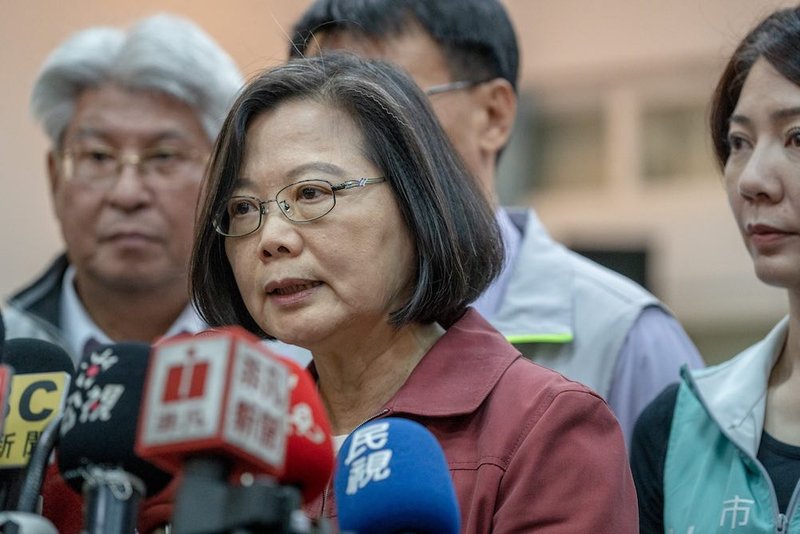
More disruptive still, Guo Tai-ming, Terry Gou, the chairman of technology giant Foxconn, has announced he will stand in KMT presidential primaries. Guo is a corporate heavyweight and political player in Beijing and the US, but as shown in his recent outburst at a high-level event in Taipei with senior US representation to commemorate the 40th anniversary of the Taiwan Relations Act, he is untested and capricious as a political campaigner.
On the DPP side of politics, Tsai has not been travelling well in recent polling. She is facing a primary rival in William Lai, premier until his resignation in January and before that the popular mayor of Tainan. Lai is a skilled politician with a strong base in southern Taiwan, but a mixed record as premier. In a party that can be sceptical of the technocratic political style that Tsai exemplifies, he could still replace her as the 2020 DPP candidate.
Tsai, however, received a much-needed domestic boost from her robust refutation of Xi Jinping’s January speech on Taiwan, and she has a strong social media campaign infrastructure that will pay dividends closer to the election. Importantly, led with policy discipline, Tsai’s administration has mobilised support across the US system in the context of a distracted and chaotic US presidency and deep US government concern about Xi’s China.
Not since Lee Teng-hui’s terms in the 1990s has a Taiwanese president enjoyed this level of US support and none of her rivals could claim to equal it.
Beneath the noise of Taiwan’s politics are tectonic geopolitical and historical forces. The DPP stands on the legacy of more than a century of the pursuit of democracy and self-determination by the Taiwanese, back to the 1920s and the Japanese colonial era, the 1947 uprising, and through the activism of the 1970s. The KMT’s channels China’s republican history and the civil war, as well as Taiwan’s tiger economy and authoritarian past. Into this have entered new and compelling politics around generational change, gender, environmentalism and anti-capitalism. Neither main party can fully contain these forces in their policies and political styles.
Beijing hovers over this and will be observing with a degree of frustration. Xi’s January speech spoke to a geopolitical landscape that was relevant in the immediate post-Mao period but not to the immeasurable changes in both Taiwan and China over the last 40 years. It expresses the nature of the People’s Republic of China system and policies locked by ideology that Xi was unable to make the most obvious move – to call for a summit between him and Tsai – that would have put Tsai in a difficult position while strengthening Beijing’s on the Taiwan issue internationally.
There are many months until the election and many surprises lie in store. Taiwan’s democratic history shows that in a long and uncompromising election campaign, the international community can expect the candidates to be scrutinised by an electorate with an acute understanding of Taiwan’s complex history and the difficult place it occupies on the fault lines of international geopolitics.
Mark Harrison