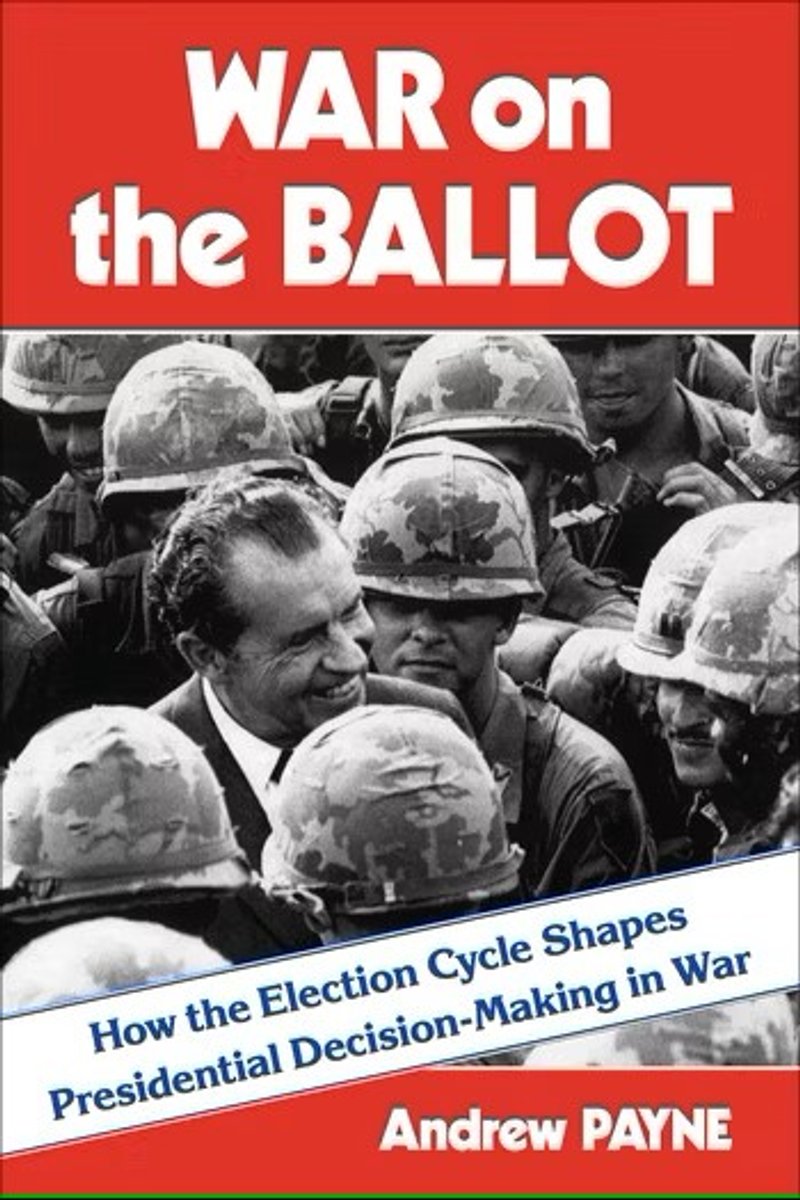
Finally, Payne highlights the capacity of a spoiler mechanism to thwart a president’s efforts to de-escalate a conflict, particularly during the lame duck period of his presidency. Examples of this mechanism in action include the failed peace-making attempts of presidents Truman and Johnson (1950 and 1968) and later in the Bush administration with Iraq. Payne’s careful research shines in these “lame duck” phases when we witness a dramatic power shift from the president to the incoming administration, and US allies and adversaries who also consider likely election outcomes and make anticipatory moves.
In three areas I disagreed with Payne’s analysis.
First, I would have liked Payne to treat electoral pressures seriously by including the advice and perspective of political advisors and party leaders and domestic policy allies alongside the perspective of military and defence professionals. This would certainly complicate the model but would ultimately be a more realistic representation of political reality. In a democracy, the question is rarely, did the president choose the national interest over political interest, or the strategically optimal over the politically pragmatic? Rather, the question is – all things considered – did he seem to get the balance right?
Second, Payne’s model relies on being able to demonstrate that the president believed that a certain choice was strategically preferrable and then modified that choice to suit his political circumstance. But at times, Payne allows the strategic preference to be defined by retrospective analyses of the conflict or by the military. For example, it’s not clear that Johnson believed in the utility of any of the options he considered in 1963-64. There’s also no evidence that Obama agreed with the conditions-based withdrawal that was the strategic preference of military and civilian defence leadership.
The interviews Payne conducted with Bush and Obama era officials meaningfully contribute to the feeling of being present during behind-the-scenes deliberations. But the Iraq war remains a contested issue, and the legacy of these officials is inextricably tied to that war. Their perspectives are valuable but not interchangeable with the national interest.
Finally, I share Payne’s concern about the opportunity costs and needless bloodshed associated with specific wartime decisions but see these examples as only part of the story. In Vietnam and Iraq, the foreign policy disasters that loom largest in the American imagination, the escalatory inclinations of Nixon and Bush were at first tolerated and/or encouraged by electoral pressures. However, both presidents were also constrained by elections in their second term. It’s possible to argue that the system works in the end.
But presidents make a lot of mistakes – some but not all electorally motivated – and democratic accountability is ultimately a lagged response. That lag, in the context of a war and an increasingly powerful presidency, is often too long to forestall disaster.