Subscribe to The Informer for monthly expert analysis, and to Events for advance notice of visiting world leaders and distinguished guests.
You may unsubscribe from Lowy Institute newsletters at any time. For information on our privacy practices and how to unsubscribe, see our Privacy Policy.
Newsletters
Subscribe to The Informer for monthly expert analysis, and to Events for advance notice of visiting world leaders and distinguished guests.
You may unsubscribe from Lowy Institute newsletters at any time. For information on our privacy practices and how to unsubscribe, see our Privacy Policy.
The missing middle: A political economy of economic restructuring in Vietnam | Lowy Institute
Economic restructuring and greater integration with the international economic system has brought Vietnam impressive gains in wealth, trade, and investment.
Such efforts have not, however, resolved Vietnam’s ‘missing middle’ or the lack of a productive domestic private sector and the continued dominance of the state-owned sector.
While these challenges represent a risk to Vietnam’s future growth potential, initiatives such as the Comprehensive and Progressive Agreement for Trans-Pacific Partnership provide an opportunity for further trade and investment expansion.
Executive summary
Vietnam’s cautious and sequenced adoption of market institutions has brought more than two decades of impressive economic performance, all while leaving the country’s underlying political economy largely intact. Notably, Vietnam has leveraged greater integration with the international economic system, including through ascension to the World Trade Organization in 2007 and the conclusion of a spate of free trade agreements, as a means of reinforcing domestic change.
Such efforts, however, have not resolved Vietnam’s ‘missing middle’, or the dearth of a productive domestic private sector and the continued dominance of the state-owned sector. As a result, impressive levels of exports and investment have not yet resulted in concomitant gains for domestic value added or linkages to domestic firms. As these challenges represent serious risks to Vietnam’s future growth potential, it is important to find new methods to bolster institutions and reduce the role of state-linked actors. The historical importance of international trade agreements in the Vietnamese system means initiatives such as the rebranded Comprehensive and Progressive Agreement for Trans-Pacific Partnership presents an unusual opportunity — both for assisting Vietnam’s current economic restructuring, as well as creating a framework for further expansion of trade and investment with other important economic partners.
Photo: Nguyen Trong Bao Toan/Getty Images
Introduction
Over the past decade, Vietnam has emerged as Southeast Asia’s most intriguing economic story. Not because it is the region’s largest economy (a title that belongs to Indonesia) or its fastest growing (a position that moves between Myanmar, Cambodia, and Laos). It is because economic restructuring has brought impressive gains in wealth, trade, and investment — all while leaving the country’s fundamental power structure largely intact.
Successful economic restructuring has, however, also contributed to Vietnam’s primary economic challenge today, namely how to address its ‘missing middle’ — the lack of a productive domestic private sector. Indeed, Vietnam’s tremendous success boosting exports and attracting foreign direct investment has not yet unwound extensive state ownership or forged linkages between export-focused industries and the rest of the domestic economy. As a consequence, Vietnam has struggled to reap the full benefits of its impressive trade and investment performance.
This Analysis begins by providing background on the development of Vietnam’s economy and its transition from a planned economy to one with many market features. It then examines Vietnam’s current economic challenges, including those raised by the US withdrawal from the Trans-Pacific Partnership (TPP). It concludes with a discussion of the Australia–Vietnam relationship. The paper includes insights gathered during field research in Vietnam during May and June 2017.
Vietnam at centre stage
In mid-November 2017, the attention of the world’s economic policymakers and analysts fell on the unlikely location of Danang, a coastal city in central Vietnam which hosted the Asia-Pacific Economic Cooperation (APEC) summit. While President Donald Trump’s meetings with world leaders such as Xi Jinping and Vladimir Putin attracted the most attention, even more important was a series of meetings in the margins of the summit.
Eleven of the twelve signatories to the TPP (the so-called ‘TPP-11’) met to seek a way forward for the ‘high-quality’ trade agreement, the future of which was thrown into chaos after Donald Trump kept a campaign promise and withdrew the United States from the TPP in January 2017. Vietnam, for its part, initially announced it would depart the agreement but continue to implement the reforms to which it had agreed. Later, however, having already invested heavily in steering many of the agreements through its political system, Vietnam returned to the fold as part of the TPP-11. At Danang, Vietnam signalled its support for the agreement pending greater flexibility for the implementation of its commitments on labour protections.
As the lowest-income member of the TPP, and a country that is heavily dependent on trade, Vietnam provides an important case study for future multilateral trade liberalisation. Integration with the world economy has brought Vietnam impressive gains in wealth, trade, and investment, but has also brought new challenges, including a lack of progress in unwinding state economic ownership, in boosting productivity, and developing a competitive private sector. As a consequence, its economy suffers from a ‘missing middle’, or shortage of private medium-sized enterprises.
Central to the original appeal of the TPP — beyond new access to the US market for Vietnamese exports — was a justification for addressing these challenges. In the context of Vietnamese economic history, such outside agreements have been used to support the implementation of difficult domestic change. As a result, the news out of the Danang APEC summit that the TPP-11 had agreed, in principle, to the core aspects of an agreement — rebranded as the CPTPP (Comprehensive and Progressive Agreement for Trans-Pacific Partnership) — was a positive step for Vietnam.
Although the gains that Vietnam can expect under the eleven-nation agreement are not as great as if the United States were included, it will still benefit from expanded trade opportunities, more investment and added ammunition to address some thorny challenges in its domestic economy. Perhaps most importantly, Vietnam will be part of what is likely to be the prime piece of architecture for future multilateral trade liberalisation in the region. Although not a panacea, a framework such as the CPTPP that is predicated on quality domestic institutions and standards would assist Vietnam with its most pressing economic challenges.
Vietnam’s economic journey
Vietnam is one of Southeast Asia’s standout economic performers. It has strong fundamentals with favourable demographics, good income distribution, and attractive human capital compared to similar countries.[1] With a population of more than 90 million and a growing middle class, Vietnam is increasingly emerging as an attractive market in its own right.
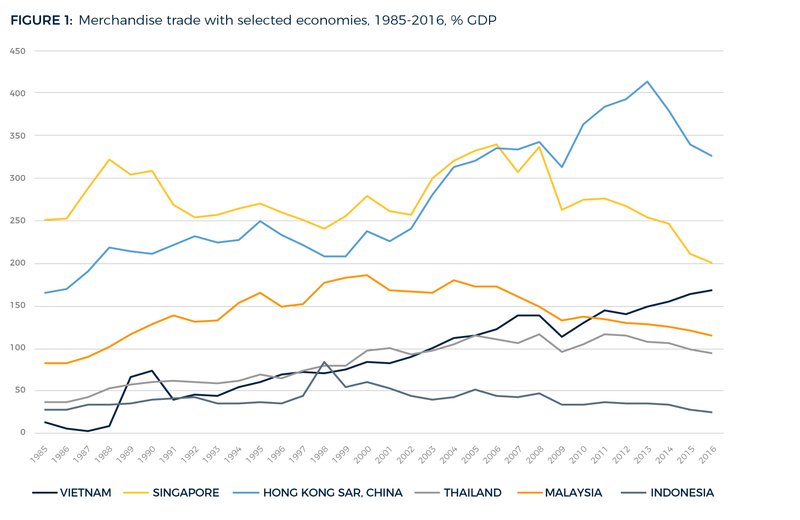
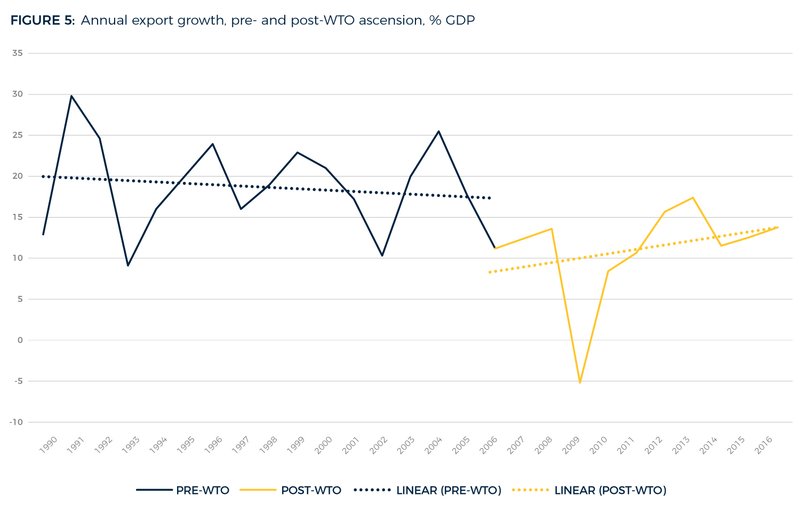
All of this is reflected in Vietnam’s impressive economic track record. The country is rightfully touted as evidence of the potential gains for developing countries that choose openness and trade. During the 2000s, its GDP per capita increased an average of 7.9 per cent per annum. Since 2010, annual growth averaged 6.5 per cent and in 2016 reached 6.4 per cent. After joining the World Trade Organization (WTO) in 2007, Vietnam’s exports more than trebled from US$45 billion in 2006 to US$190 billion in 2016. Over the same period, merchandise trade as a share of GDP expanded from 127 per cent in 2006 to 173 per cent in 2016.
Vietnam’s trade dependence is not far behind the city state economy of Singapore (206 per cent of GDP), and well in excess of regional peers such as Malaysia (120 per cent), Thailand (100 per cent), and Indonesia (30 per cent). According to one Vietnamese economic adviser interviewed by the author, “We had no choice and had nothing to bring [to the world market] besides our trade.”
A web of 16 free trade agreements (FTAs) have helped Vietnam become deeply embedded in global value chains. Vietnam’s political stability, low labour costs, favourable tax and investment terms, and FTAs have seen it emerge as an attractive exporter to more developed markets. Vietnam has attracted large amounts of foreign direct investment (FDI), including a record US$15.8 billion in 2016, up 9 per cent from 2015. Technology multinationals such as Intel and Samsung, which assembles nearly one-third of its smartphones in Vietnam, are large investors in the country. Mobile phone handsets and related parts now make up 20 per cent of Vietnamese exports. The country is also the second-largest supplier of apparel to the United States, Japan, and South Korea.
Vietnam’s potential is underpinned by the progress it has made on key human development indicators, including maternal health, electrification, and literacy. In 1993, more than half of the population lived in ‘extreme poverty’. Today that rate has fallen to 3 per cent, with more than 40 million people coming out of poverty over the past two decades. As at 2015, Vietnam had achieved its Millennium Development Goal of universal primary education with a net enrolment of 99 per cent, and was well on its way to the same target for lower secondary education. Vietnamese students have thrived particularly in science, technology, engineering, and mathematics. Vietnam outranks many developed countries in the OECD’s PISA (Programme for International Student Assessment) rankings, particularly in science and mathematics.
Such performance is remarkable for a country that 30 years ago was almost completely impoverished. The contrast with Vietnam’s current economic situation, and especially its integration with the global economy, is particularly stark and makes the transformation even more noteworthy. Prior to 1986, central planning was dominant in Vietnam. Private trade and manufacturing was nationalised and collective farming meant most citizens were not permitted private agricultural plots. In 1986, the Communist Party of Vietnam began introducing price and market mechanisms (known as Doi Moi or ‘economic renovation’) aimed at transforming the economy.
The growth of these price and market mechanisms was not the product of a single ‘reform’ moment. Rather it was the accumulation of three decades of incremental change. Policymakers adopted a pragmatic approach to the introduction of market features and loosening the reins of central planning. Three features stand out: leveraging trade and global value chains to grow exports; deploying external commitments to lock in domestically agreed reforms; and restructuring the existing political economy while leaving dominant power structures largely intact.
After reunification in 1975, Vietnam had a largely centrally planned economy, albeit with a considerable informal sector (for example, food vendors, bicycle repairers, hairdressers). Official experimentation with prices and markets began slowly, as some prohibited activities — known as ‘fence breaking’ — were permitted. In agriculture, for example, this included allocating land to farmers and directly contracting for production at prices higher than the plan. Vietnam was then dependent on food imports, and efforts to renovate the agricultural sector not only freed up labour but also generated food commodities that improved the terms of trade. There were also efforts to boost manufacturing and heavy industries such as chemicals and shipbuilding, which were modelled on the systems of South Korea and Taiwan, sometimes with unintended consequences. For example, ill-advised attempts to emulate South Korean chaebol-led industrialisation culminated in the near bankruptcy of state-owned shipbuilder, Vinashin.
Crucially, the introduction of market mechanisms was managed by the state. Fence breaking activities often relied on quasi-official forms of approval or licensing. Early examples of liberalisation took the form of normalising smuggling or illegal trade already sanctioned by local officials — and usually carried out by managers of state-owned enterprises (SOEs). Such tacit approvals not only created markets for otherwise illicit commodities, but also for the official positions that controlled these activities. In fact, this coalition of local officials and SOE managers — who were the prime beneficiaries of fence breaking — represented the main force lobbying their more senior party peers to accept these market changes.
The prime beneficiaries of liberalisation were state firms, which under previous collectivisation and central planning controlled most land and assets. State firms expanded rapidly, even amid periodic culls following build-ups of state credit (and, inevitably, bad loans). In the early 2000s, many SOEs were subject to some form of limited privatisation (especially of asset-holding subsidiaries), a policy that was accepted because it furthered the interest of state-connected actors. In the absence of a true commercial class able to acquire and manage divested assets, privatisations ended up funnelling valuable assets, such as land, from SOEs to private companies under the control of these actors. Privatised companies retained their connection to the state, as the government kept nearly two-thirds of SOE shares sold during the main period of privatisations from 2001 to 2011. This was also a feature of the near complete absence of domestic commercial interests, and many SOEs expanded into sectors such as real estate, retail, and banking.
Vietnam also embraced international commerce as a core strategy of its economic renovation. Bilateral trade liberalisation agreements were concluded with the United States in 2001 and the European Union in 2003. Exports expanded as a share of GDP from 30 per cent in 1990 to 50 per cent in 2000 to nearly 94 per cent in 2016. Many in Vietnam talk about how the government has used its international trade and investment agreements as a way of complementing their economic restructuring efforts. Agreements also often came with technical assistance, which made changes even more palatable. As a result, the potential collapse of the TPP during early 2017 hit hard domestically, as those pushing for further economic renovation had pinned their hopes on the commitments and assistance they could expect under the TPP. Not all agreed, however, and the agreement’s generous access to markets such as the United States for large industries including the garment trade was critical for assuaging domestic opponents. Interlocutors in Vietnam bemoaned the loss of the anticipated ‘attitude adjustment’ of officials and vested interests more than any preferential market access that they would have gained from the agreement.
Vietnam’s three pillars of pain
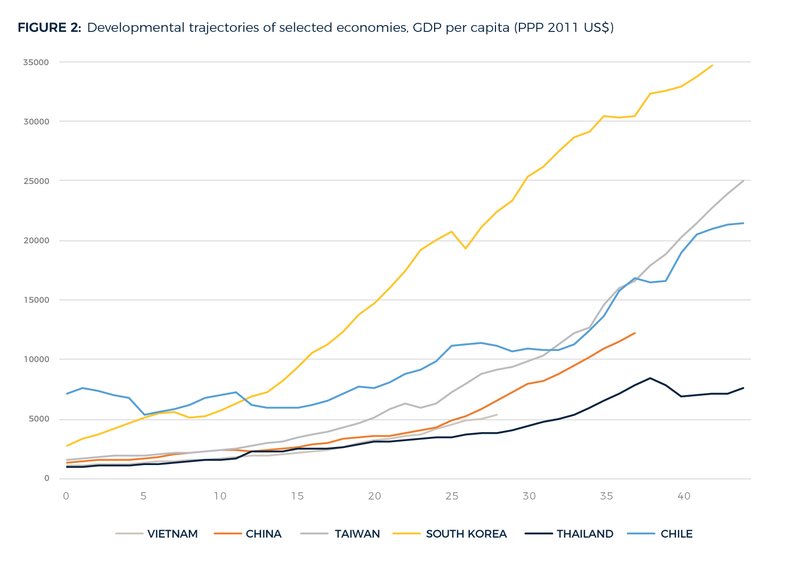
Vietnam’s economy has performed impressively, but it also faces an emerging conundrum. Having already realised the gains from integration with global value chains, demography, capital investment, and macroeconomic stability, Vietnam may struggle to ‘catch up’ to more developed economies before the economic gains from a young population and greater capital investment are exhausted. One World Bank study has found that Vietnam requires an annual GDP growth of 7–8 per cent to reach the current position of Asian economies such as Taiwan and South Korea by 2035. Currently, Vietnam is struggling to reach 6.5 per cent annual growth. It remains in a strong position, but its current relatively young population will age rapidly in the coming decade, and its rate of ageing will be among the highest in the world from 2030 onward.
Notes: Adapted with modification from World Bank; Ministry of Planning and Investment of Vietnam, Vietnam 2035: Toward Prosperity, Creativity, Equity, and Democracy (Washington DC: World Bank, 2016), 18. Base years are 1951 for Taiwan, 1958 for Thailand, 1970 for Chile, 1972 for South Korea, 1977 for China, and 1986 for Vietnam.
Source: Author’s calculation; Penn Tables, Version 9.0
The most pressing challenges are consistent with its need to maintain a high rate of economic growth. Vietnam has undertaken ‘three pillars’ of economic restructuring: resolving bad debts in the banking sector; rationalising the state-owned sector, and improving the quality of public investment. The three issues are closely intertwined.
Bad debt
The economic reforms required in order for Vietnam to join the WTO in 2007 meant it became much easier for capital to enter the country. Vietnamese enterprises, which lacked competitiveness, did not gain from WTO ascension. The subsequent reversal of capital flows saddled the country with a weak currency and high inflation, and revealed a banking system with high rates of non-performing loans. Many of these loans were to Vietnam’s 13 large state corporations and were often extended by private banks owned by these same conglomerates.
Unwinding the debt overhang has proven difficult. The government issued a ‘roadmap’ for bank restructuring in 2012. A handful of weak banks were merged, and in 2013 the Vietnamese Asset Management Company (VAMC), was set up. VAMC swapped non-performing loans at cost from banks in exchange for VAMC-issued ‘special bonds’ that provide collateral for borrowing from the central bank. By June 2015, official non-performing loans fell from more than 17 per cent of total banking assets to less than 4 per cent. The strategy was a success, as it fenced off non-performing loans and allowed most banks to continue operating while avoiding a full-blown crisis.
A similar strategy to arrest lending, discipline renegade banks, and lock down bad loans so the financial sector could, over time, outgrow them was also pursued after breakneck credit expansion in the early 2000s. However, the scale of the debts — likely more than US$20 billion (or 10–15 per cent of GDP) — makes it difficult to outgrow it even with strong economic growth. With the absence of a secondary market for non-performing loans, many banks assume the bad loans will eventually return to their balance sheets.
State-owned enterprises
SOEs are responsible for the largest share of bad loans in Vietnam and were the catalyst for the banking sector’s troubles. Vietnam maintains a majority stake in more than 3000 SOEs. Although they account for around 30 per cent of GDP, and about 40 per cent of total investment, their share of economic activity has not changed since 1990. They also provide less than 5 per cent of total employment; an estimated 92 per cent of employment comes from small private firms. SOEs have consistently grown more slowly and used capital less efficiently than other enterprises, soaking up resources and ‘crowding out’ private sector development in the process.
Addressing the dominance of SOEs would help strengthen banks. The large number of inefficient SOEs are a strain on the financial sector’s efficient allocation of national savings. In November 2015, the National Assembly ratified an economic restructuring plan for 2016–20 with SOE reform and restructuring of the financial sector among its leading priorities. Sensitivity about selling assets cheaply, however, has slowed both SOE privatisation as well as bank restructuring.
Progress can be undermined by Vietnam’s political economy. Most SOEs are not centrally controlled. Local state actors have responded to the privatisation drive by devolving SOEs’ valuable assets such as land into subsidiaries with murky and in many cases quasi-private ownership structures. Land is particularly important, as it also serves as collateral for bank borrowing, often fuelling real estate speculation and cycles of booms and busts. Land use rights are non-permanent and location-bound, and there is no primary market for trading land use rights. Altering land use classifications can be prohibitively expensive, especially for small and medium-sized enterprises (SMEs) and citizens. Observers believe more formalised and tradeable land use rights would benefit SMEs, deepen financial inclusion, and help facilitate longer-term borrowing and lower interest rates. However, a more flexible land-use regime would also alter the privileged relationship between SOEs and banks, which would also find it difficult to operate without a ready-made SME sector to provide alternative borrowers.
Improving public investment
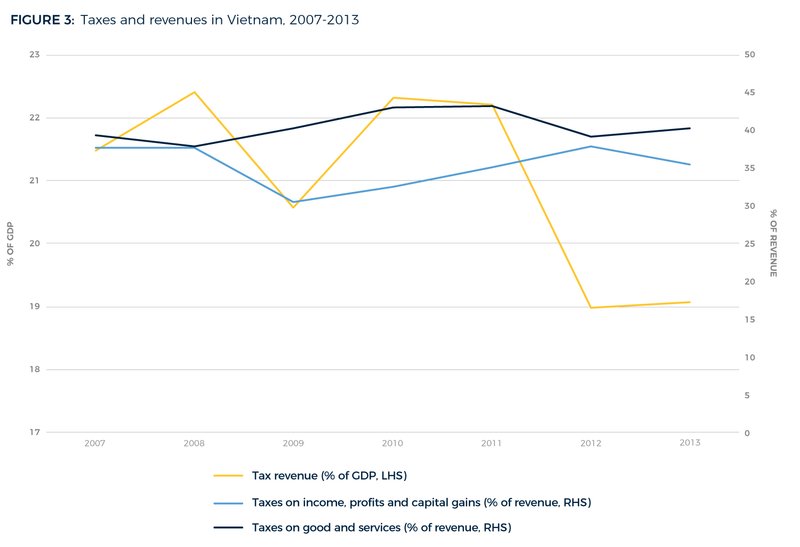
The Vietnamese Government also lacks the fiscal space to write down these non-performing loans or bail out SOEs. With its budget deficit exceeding 6 per cent of GDP for each of the past five years, Vietnam has effectively reached its self-imposed 65 per cent debt-to-GDP ceiling for 2016–18. In fact, this fiscal constraint has seemingly led to some progress on SOE restructuring, with sales of strategic stakes and even initial public offerings for major SOEs announced in 2017. Other sources of revenue remain flat despite strong economic growth, with total tax revenues under 20 per cent of GDP and the share from income and profit taxes a meagre 35 per cent of total tax.
Source: World Bank, World Development Indicators, https://data.worldbank.org/data-catalog/world-development-indicators
Of perhaps greater concern than the fiscal constraint of the debt ceiling is the low quality of existing public spending, much of which takes place at the subnational level. Vietnam’s central transfers are highly progressive and became more so during 2007–11, and have helped drive regional-urban convergence in access to services and measures of welfare. It is widely known, however, that the quality of public investment is often uncoordinated and incoherent because of fragmented governance structures. As a consequence, there is acceptance within government that simply adding cash to an ineffective system without first addressing spending quality would lead to certain waste. There is little serious discussion of expanding the debt ceiling beyond 65 per cent of GDP, which is relatively restrained in contrast to some comparator countries. The continued ballooning of the public sector and a decentralised governance framework also contribute to public investment without adequate accountability and oversight. Changes to the investment regime, including around the time of Vietnam’s ascension to the WTO, led to the decentralisation and streamlining of investment approvals to local authorities. Local governments have in turn aggressively pursued investment, especially FDI. Competition between local governments to attract foreign investment has at times been productive and at times wasteful. One example of waste and duplication has been the number of ports and airports that have been built. Often this is the result of a process in which provincial governments conceive of infrastructure projects and pitch them to central authorities, with approvals sometimes difficult to explain outside of an opaque intra-party process.
Importantly, these contemporary policy challenges — namely, the dominance of SOEs and low quality of public investment — have emerged as a consequence of historical restructuring strategies. Initial fence breaking efforts to introduce prices and markets were successful in large part because they expanded the authority of local officials and affiliated SOEs. As a result, local interests played an important role in persuading central planners that their illicit trade and other prohibited activities could be safely sanctioned and successfully expanded without radically undermining the prevailing political economy. Today, however, analogous power structures may have different priorities. For example, as central planning receded, local governments acquired more responsibilities, which because of budget constraints and a reliance on access fees, led to the empowerment of local SOEs to raise revenues, raise financing for, and develop infrastructure and other politically connected projects.
However, progress is being made. A new Law on Public Investment introduced in 2014 has instituted stronger controls on local government budgeting. Provincial governments now have debt ceilings, although they remain in control of how much and from where they can borrow outside this. The 2015 State Budget Law introduced a medium-term framework for public budgeting. Such measures raise the challenge of balancing the government’s growth target with the need to improve the quality of public investment while continuing investment in economically important items such as infrastructure.
Vietnam’s missing middle
Vietnam’s three restructuring priorities — bad debts in the banking sector, SOE reform, and public investment — are all related to the challenge of the missing middle. Despite Vietnam’s success boosting investment and exports, developing the domestic private sector has proven difficult.
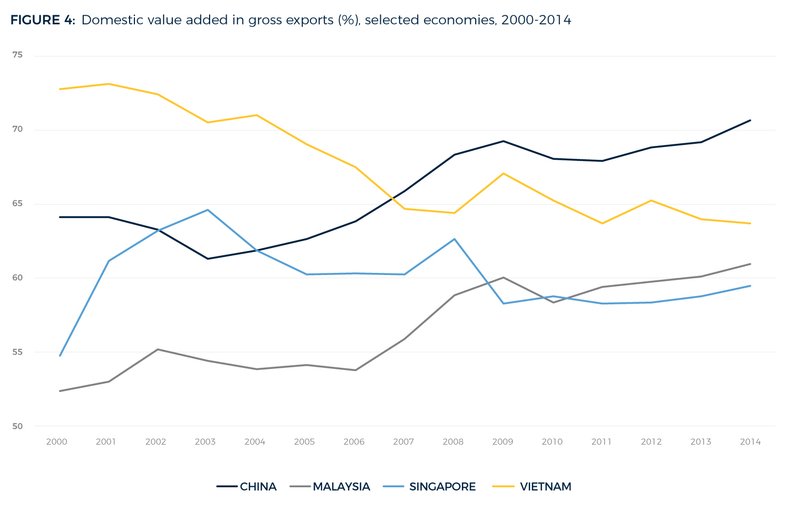
Vietnam’s economic successes have derived from trade and investment liberalisation, and competitive labour and service linkage costs, allowing it to carve out an impressive niche in global production networks. At the same time, however, Vietnam has seen productivity fall, with the largest falls in the domestic private sector. Many export-oriented sectors have limited links to domestic suppliers or service providers. They also rely on global supply chains with a large share of imported inputs, often across several steps that experts describe as structural supply chain ‘breaks’. In the case of Vietnam, these features may become especially pronounced because it has derived much of its competitiveness from taxation, investment facilitation, and low labour costs.
Source: OECD, “Domestic Value Added in Gross Exports”, https://data.oecd.org/trade/domestic-value-added-in-gross-exports.htm
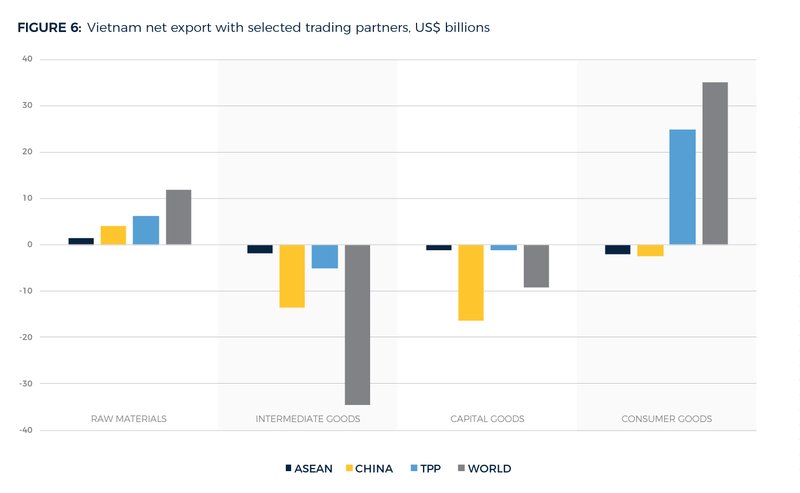
The garment and footwear sectors, the second- and third-largest export sectors, demonstrate how large exports and trade surpluses do not always mean commensurate levels of domestic value added. On the contrary, value added domestically can be small when investments are highly integrated into global supply chains. In these sectors, much of the value added derives from Vietnam’s low labour costs. Many inputs are imported, often across several steps of the value chain with intermediate inputs exported, processed abroad, and then reimported. Vietnam runs a $32 billion trade surplus with the United States, but only an estimated 5–8 per cent of this accrues as value to Vietnam. Personal electronics from major brands such as Samsung and Intel form a large share of bilateral trade, but the value of exports can be as low as 3 per cent of a product’s final value. The corollary of surpluses with one country are even larger deficits with a third country (often China), as manufacturers must import inputs, capital, and even production lines.
Table 1: Vietnam’s trade with selected partners, 2014 (US$ billions)
There is a saying in Vietnam that SOEs are your son, FDI enterprises are your mistress’s son, and private enterprises are somebody else’s son. Few aphorisms better encapsulate the challenge of broadening the economy to address the missing middle. Too often, SMEs come a distant third behind SOEs and foreign investors. More than 95 per cent of Vietnamese companies are small-scale, and they struggle with lack of access to credit and land, and are usually reliant on old, often second-hand technology. Foreign investors often negotiate directly with local governments to obtain highly competitive terms related to taxation and access to land. This makes it difficult for SMEs to compete, and a lack of domestic competitiveness over the past ten years means larger export-focused FDI enterprises have little incentive to build business links to these less competitive domestic firms.
Addressing the missing middle is not as simple as empowering a downtrodden private sector. Vietnam has never had an influential domestic commercial class, and the implementation of selected market institutions has reflected the priorities of those within the state. Most crucially, over the past 15 years Vietnam’s private sector has struggled to compete as the economy has become more open internationally. The lack of sufficient progress on tackling institutional and policy impediments, such as expanding financial inclusion or creating more effective land rights, has reinforced the trend. Vietnam’s various FTAs and international trade arrangements also make it difficult for the government to extend subsidies or special treatment to its SMEs, for example.
Source: World Bank, World Development Indicators, https://data.worldbank.org/data-catalog/world-development-indicators
For many supporters of economic renovation, the TPP was seen as an attractive tool as it promised to tackle some of Vietnam’s major economic problems. This courting of external support demonstrates how economic openness and domestic reform have historically gone hand in hand. Joining the WTO not only meant tariff and services liberalisation, it also allowed policymakers to push through nearly a decade’s worth of new commerce and business regulations and policies. Not everyone in Vietnam feels that all of these changes were in the country’s best interests. Many, for example, point to evidence that domestic enterprises lacked the competitiveness to benefit from greater exposure to international economic forces. Even knowing this, most would choose the path of openness because of the opportunity it provided for parallel restructuring and change.
For Vietnam, the Trump administration’s withdrawal from the TPP removed the most readily apparent benefit: preferential access for garments and textiles to the US market. This would have made Vietnam one of the TPP’s biggest winners of the trade deal. An estimate of its gains from prospective tariff elimination was 6.8 per cent of real GDP, versus 1.1 per cent under the TPP-11. Without the United States, Vietnam’s exports seem likely to grow less rapidly: under one estimate, exports to TPP members would have grown by 12 per cent by 2035, versus 6.8 per cent under TPP-11. Real GDP will still increase with TPP-11, but at a far more muted 0.5 per cent by 2035, versus 1.9 per cent initially. As a result, selling TPP-11 domestically will become more difficult. True to Vietnam’s track record, however, many TPP backers emphasised the agreement for disciplining policymakers and deflecting domestic opposition. Officials interviewed by the author spoke of the agreement’s inherent “attitude change” or “mindset”; another explained, “without TPP many promises will fall by the wayside”.
Source: UN Comtrade, International Trade Statistics Database
Another potential benefit for Vietnam were the TPP’s proposed rules of origin. The rules would have provided preferential treatment for goods with inputs sourced from TPP countries (or within Vietnam). This would have helped bring in high levels of investment from suppliers seeking to take advantage of the new rules. As discussed above, efforts to limit structural supply chain breaks would help boost Vietnam’s domestic value added. During 2014–16, an estimated US$5 billion of FDI from China flowed into the garment and textiles sector as suppliers positioned themselves to leverage gains from the TPP. Once the TPP became uncertain, such investment quickly tailed off. Finally, the TPP would also require Vietnam, perhaps conveniently, to reduce its support to SOEs and introduce new public procurement practices. Other changes including those related to intellectual property were slated to be accompanied by US technical assistance for Vietnam.
Vietnam and Australia
Australia’s economic relationship with Vietnam is advancing, and the countries’ trading relationship is the fastest-growing among the larger ASEAN economies. Two-way trade now exceeds A$10 billion. Vietnam is among the largest users of tariff preferences under the ASEAN–Australia–New Zealand Free Trade Area, an indication of its increasing trade with Australia. Australian officials believe there are opportunities for Australian businesses to grow their market share in the agriculture, education, energy, financial services, and tourism sectors.
According to the Department of Foreign Affairs and Trade, there are more than 22 000 Vietnamese students in Australia, the fourth-largest group of foreign students. RMIT University was the first foreign university to set up a campus in Vietnam, and a growing number of Australian universities have partnered with Vietnamese institutions to deliver degrees in Vietnam, offer student exchanges, or provide pathways to further study in Australia. Food is integral to Vietnamese local culture, and there is rapidly growing demand for high-end beef, wine, and dairy, with Australian produce enjoying strong in-market recognition among increasingly affluent consumers. Strong expected growth in mini-markets and e-commerce should provide a special opportunity for exporters that adapt an innovative approach to packaging and portioning of premium products.
There is also a considerable Vietnamese diaspora in Australia. According to the 2016 Census, nearly 230 000 people reported speaking Vietnamese at home, and of the 40 per cent of Australians born overseas, 3.6 per cent (the sixth-largest group) are Vietnamese. Long-held community disapproval of business or commercial ties to Vietnam within the diaspora — unsurprising given many Vietnamese–Australians emigrated as refugees — are beginning to fade among younger Vietnamese–Australians and with new generations of migrants. As the Vietnamese Government actively attempts to tap overseas Vietnamese — the so-called ‘Viet Kieu’ — as a source of investment and human capital, Australia’s substantial Vietnamese population could contribute to a further expansion of ties.
Australia’s other priorities and relationships in the region also recommend an interest in Vietnam. Vietnam has natural affinities with Australia in the security sphere, from their independent foreign policies and emphasis of the ‘rules-based order’ to regional maritime security issues in the South China Sea. Both countries also have an established relationship with key economic and strategic player Japan, which has emerged as the new coordinator of efforts to revive the TPP-11 agreement. Vietnam and Australia concluded an Enhanced Comprehensive Partnership in 2015, and the bilateral relationship includes strong development, education and training, and defence ties. Defence ties were established in 1998, with expanded bilateral dialogues and talks in recent years. Several Australian warships have made port calls in Vietnam in the past two years, and Australia is providing assistance to Vietnam’s first UN peacekeeping deployment.
Conclusion
The results of Vietnam’s three decades of economic transition are impressive. A range of factors helped Vietnam to attract investment and boost exports, including: a competitive investment regime; trade liberalisation; engagement with the international economic system; political stability; and low labour costs. The path of economic restructuring has been pragmatic and omnivorous. Its economic planners avoided debates about capitalism and instead justified the introduction of markets as a way of encouraging greater production and trade.
Yet, while trade and foreign investment are indispensable features of Vietnam’s economic success, they have not automatically translated into the creation of a vibrant and competitive private sector. Boosting Vietnam’s private sector has foundered on the dominance of the country’s numerous SOEs, which under current policy settings continue to dominate market access, credit and investment, and control of physical assets. Export-oriented foreign investment has been attracted by an open trade regime and stable investment framework, but this has also limited incentives to build linkages to local suppliers and service providers. Thus Vietnam’s share of impressive exports and some large trade surpluses is less than might be expected. The productivity and share of domestic value of Vietnamese firms has actually declined as its economic integration has increased. Addressing this is the primary economic challenge for Vietnamese policymakers today.
Vietnam’s experience also underscores the potential downside of trade and investment liberalisation without concomitant efforts to address domestic institutions and standards. Efforts must be made to ensure domestic players also capture a slice of the gains. Indeed, the TPP’s focus on quality institutions and standards made the agreement appealing to Vietnam, even despite the certain difficulty of complying with a host of commitments on labour, environmental protection, and SOEs. Vietnam has a history of leveraging engagement with the international economic system — including joining the WTO and signing major FTAs — to support difficult domestic restructuring. These have been more pretext than driving force; many in Vietnam would note that far more laws and regulations were passed than were technically required to meet its WTO commitments.
Most importantly, at a time of rising global protectionism, Vietnam continues to look outward in a unique way. The CPTPP agreement, though not yet completed, is positive for both Vietnamese as well as Australian interests. Even without a favourable outcome among the remaining eleven TPP signatories, however, the Vietnamese system would be likely to push forward with creative and incremental ways of importing and cementing change. Vietnam regularly impresses with its resourcefulness on the world stage — illustrated by the successful visit of Prime Minister Nguyen Xuan Phuc to Washington, the first Southeast Asian leader to call on President Trump. At times, Vietnam has paid a price for its engagement with the world economy, but few in Vietnam would advocate a different path.
Acknowledgements and disclaimers
Thank you to all of the experts and practitioners who met with me throughout the course of my research, both in Vietnam and Australia. I am especially appreciative to the Australian Embassy in Hanoi and the Australian Consulate-General in Ho Chi Minh City for assisting me with my research. Your assistance and networks were invaluable, as were the conversations I was fortunate to have with your knowledgeable and professional staff.
I am also grateful to three anonymous reviewers for their helpful comments and suggestions. All mistakes in the text remain mine.
About the author
Matthew Busch is a Research Fellow in the East Asia Program at the Lowy Institute. Matthew’s research focuses on the intersection of politics and economics in the emerging economies of Southeast Asia, with particular focus on Indonesia and Vietnam. Matthew holds a Bachelor of Arts, cum laude, in Economics from Harvard College. He was also a recipient of the college’s prestigious Michael C Rockefeller Memorial Fellowship, with which he travelled to Indonesia for the first time in 2007. Matthew is currently undertaking PhD research at University of Melbourne Law School.
The Lowy Institute acknowledges the support of the Victorian Department of Premier and Cabinet for Matthew’s position.
Notes
[1] Vietnam has a relatively young population, although it is projected to start ageing rapidly. Its income levels are near the bottom of what is considered middle income, and many of its citizens are entering the middle class for the first time. In terms of human capital, great progress has been made to promote education, especially in science and mathematics.