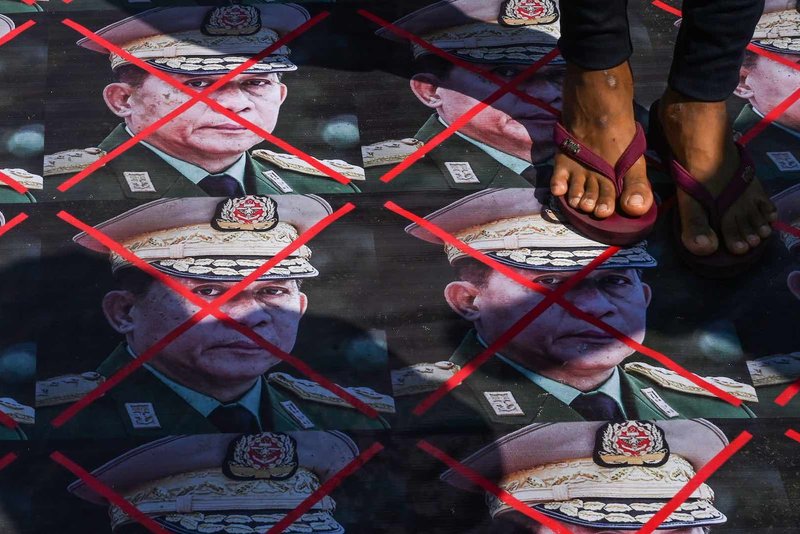
This tradition of personalised politics extends even to the security forces. Despite the formal rank structures and hierarchical organisations of their services, senior military and police officers have always cultivated circles of supporters, who owe them their personal loyalty. As far as the system allows, they act as patrons, while their subordinates become protégés. These informal support networks often act in parallel to regular systems.
One drawback to this practice, however, is that the fall of a senior officer can mean that his entourage falls with him. This was demonstrated in 2004 when General Khin Nyunt, the powerful chief of intelligence, was arrested and put on trial by his rivals within the armed forces. Almost the entire military intelligence corps was removed at the same time, as it was considered loyal to him and thus a potential threat to the wider defence services.
Min Aung Hlaing is the most senior officer in Myanmar’s armed forces and, through various military appointments, also controls the country’s police force and intelligence agencies. He thus sits at the apex of the state’s coercive apparatus. It is believed that, since his appointment as C-in-C in 2011, he has also seeded the higher command structure of all these organisations with officers who are personally loyal to him.
Min Aung Hlaing is reported to be controlling, egotistical and ambitious, and prepared to exercise power without hesitation to achieve his desired goals. He rose steadily through the ranks, despite becoming unpopular due to his failure to care for the troops below him. He developed a reputation for ruthlessness conducting operations against ethnic insurgents and had no hesitation in ordering brutal “area clearances” against the Rohingya.
Both Aung San Suu Kyi and Min Aung Hlaing are considered stubborn, strong-willed and reluctant to see other points of view. They also have strong personal interests at stake. Aung San Suu Kyi has an abiding sense of personal destiny, seeing herself as her father’s heir as the leader of Myanmar. Min Aung Hlaing is due to retire as the Commander-in-Chief in July 2021 and reportedly wishes to retain power, either as C-in-C or as the country’s president.
According to the Myanmar rumour mill, the two of them detest each other. While they initially worked out a rather awkward modus vivendi, they have reportedly not spoken for over a year. This is despite the fact that the “disciplined democracy” introduced by the former military regime in 2011 was always envisaged to be a power-sharing arrangement between civilian political parties and the armed forces.
A key issue after the November 2020 elections was apparently Aung San Suu Kyi’s refusal even to discuss Min Aung Hlaing’s claims regarding electoral fraud. Indeed, the story goes that she was very blunt in telling the C-in-C that she would not consider any challenges to the result. This reportedly caused great offence in military circles, which were already smarting from their public humiliation at the polls.
Thomas Carlyle once wrote that “the history of the world is but the biography of great men” (and women). It would be far too simplistic to reduce the nationwide uprising against the security forces in Myanmar to a competition between two people, but the question must be asked whether two leaders with different personalities, and with Myanmar's national interests at heart, might not have managed to find a way of avoiding the current impasse.
No one is advocating that Aung San Suu Kyi surrender the NLD’s emphatic win at last year's polls, which all neutral observers agree accurately reflected the country’s wish for a more democratic government. However, the price of challenging the armed forces’ self-serving vision of a “disciplined democracy” would appear to be the loss of government, massive long-term disruption to Myanmar society and blood on the streets.
Andrew Selth