And, citing nearly new 3,000 trade restrictions imposed globally during 2022, up by nearly three times compared with 2019, Gopinath lamented how trade and foreign direct investment “is now increasingly driven by geopolitical preference rather than by business fundamentals” in a fracturing environment. This is very much the case in Vietnam which is turning into a “connector country”, in economists’ parlance. Not only is the nation of 97 million posting big gains in its share of exports from China, it is also achieving even bigger gains in exports to America.
With ports leading the way, the country’s one-party government plans to carry on where it left off in 2023. Currently, Vietnam ranks only 80th in the world in terms of quality of port infrastructure but, with much of its 3,444-kilometre coastline lying on the South China Sea, it occupies an advantageous natural position from a shipping perspective.
The trade ministry has set a target of boosting exports by 6% through 2024, which most economists consider achievable. After all, Vietnam’s trade deal with the European Union agreed in mid-2019, jumped to a value of more than $50 billion in 2021, its first full year of operation.
The government also aims to double its ports’ capacity to 400 million tonnes by 2030 in a much-needed investment in modernisation and expansion. Although most of Vietnam’s 320 ports handle only coastal vessels, some “serve as nodes for the trans-shipment of goods while the larger ports are being upgraded continuously for foreign trade,” explains analyst and publisher Marine Insight.
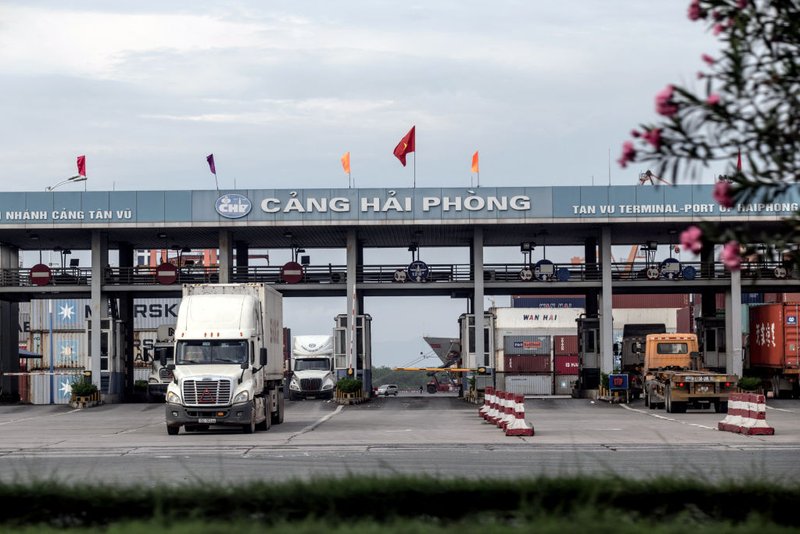
While 400 million tonnes is seen as ambitious, the government has made a start. For instance, current works at the port of Hai Phong, built by the French 150 years ago in the north of the country, are designed to accommodate bigger vessels up to 100,000 dead weight tonnes.
In contrast with its ports, the government’s ship-building aspirations have stumbled. The industry was forecast to post a compound annual growth rate of 6% between now and 2032, but the state-run Shipbuilding Industry Corporation, supposedly the flagship operation, has just collapsed into bankruptcy with enormous debts and the government is trying to rescue it.
More broadly, Vietnam’s current trade boom puts it in the frame as the next Asian tiger. Nearly 20 years ago Goldman Sachs predicted Vietnam would be ranked 21st among global economies by 2025. Today the IMF puts it at 37th with a gross domestic product of $433 billion, nearly the same as Malaysia but lagging a long way behind Poland, the current occupant of 21st position, with a GDP of $842b billion.
However, Vietnam’s prospects appear set to improve in a world of fracturing supply chains.